

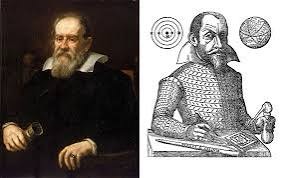
In January 1610, a pivotal moment in the history of astronomy occurred when Italian scientist Galileo Galilei pointed his newly crafted telescope towards the night sky. With a magnification power of 20 times, he focused on the majestic planet Jupiter and uncovered something extraordinary—four celestial bodies that would forever change our understanding of the universe.
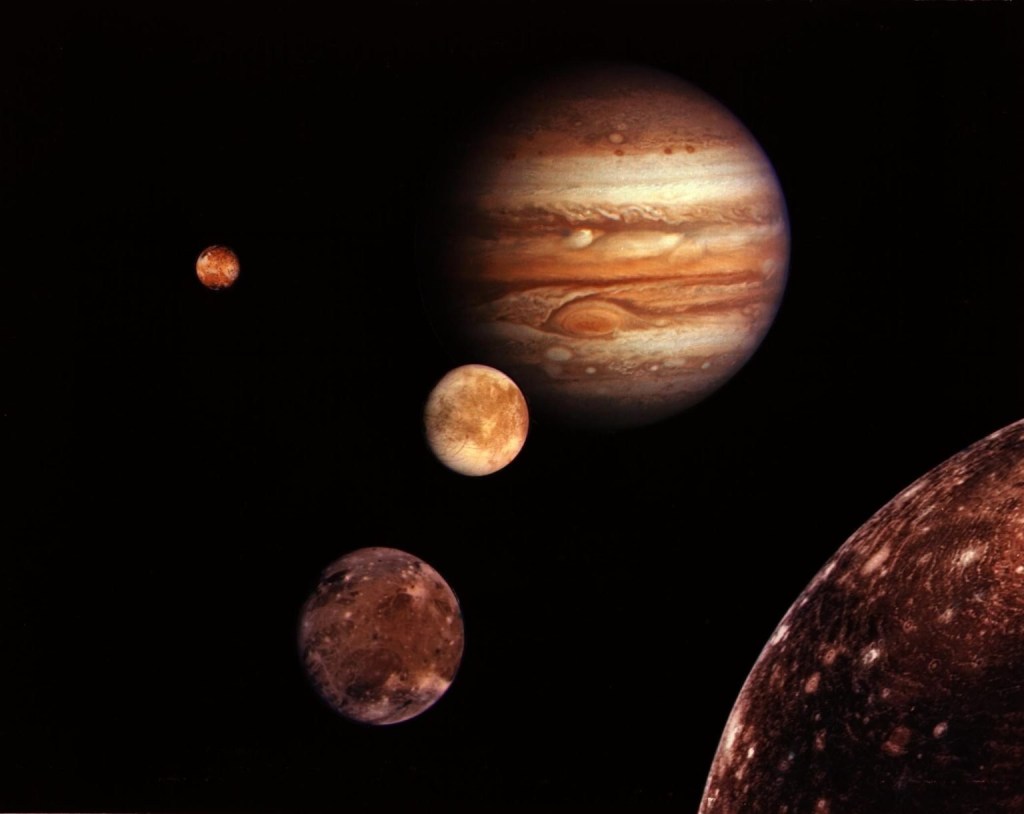
At first, Galileo believed he had spotted distant stars. However, as he meticulously tracked these points of light over several nights, he noticed a peculiar movement that set them apart. Unlike the fixed stars in the background, these objects danced around Jupiter, shifting positions relative to one another. By January 15, he confirmed his suspicions: these were not mere stars but four moons orbiting Jupiter, a revelation that provided compelling support for the heliocentric model proposed by Copernicus, which argued that celestial bodies revolve around the sun rather than the Earth.
While Galileo is often credited with this monumental discovery, it’s important to acknowledge the contributions of German astronomer Simon Marius. Marius, who was observing Jupiter independently around the same time, also discovered the same four moons. He published his findings in a book titled Mundus Iovialis in 1614, where he proposed naming the moons after the lovers of the mythological god Jupiter: Io, Europa, Ganymede, and Callisto. Although Marius’ work did not receive the same immediate recognition as Galileo’s, it played a significant role in the broader understanding of these celestial bodies.
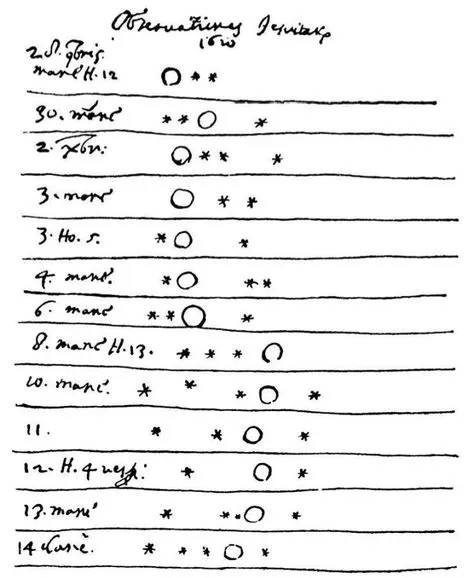
Here’s a picture of Galileo’s sketchbook showing Jupiter as a large O and each “planet” as an asterisk:c
Galileo published his groundbreaking discovery in March 1610 with his influential book, Siderius Nuncius (The Starry Messenger). In it, he detailed his observations of Jupiter’s moons and other astronomical phenomena. As the discoverer, Galileo had the honour of naming these moons, initially referring to them as I, II, III, and IV based on their proximity to Jupiter. For much of the seventeenth century, they were also known as the “Medicean Stars” in homage to his patrons, the Medici family.
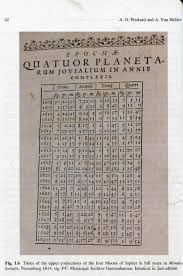

Today, we recognise these four moons as the “Galilean satellites,” a fitting tribute to Galileo, while Marius’ contributions remind us of the collaborative nature of scientific discovery.
Over the centuries, astronomers have discovered additional moons orbiting Jupiter, but attention has increasingly turned to Europa, one of the Galilean satellites. Europa is particularly intriguing due to its potential for harbouring life beneath its icy surface, prompting ambitious exploratory missions that continue to this day.
Galileo and Marius’ legacies extend beyond their discoveries; they represent a profound shift in our perspective of the cosmos. Their work laid the groundwork for modern astronomy and inspired generations of astronomers to look beyond the familiar and explore the unknown. As we gaze up at the night sky, we owe a great debt to these pioneers for igniting our curiosity and expanding the horizons of science.