

Today let us talk about Sirius, the superstar of the night sky! Known as the Dog Star or the Wishing Star, Sirius shines brighter than any other star out there. With a magnitude of −1.46, it easily outshines the second brightest star, Canopus.
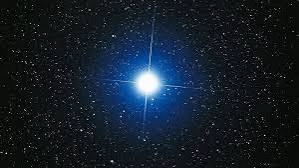
From the southern hemisphere, Sirius arcs high overhead. From the mid-northern latitudes, Sirius rises in the southeast, arcs across the southern sky, and sets in the southwest.

The name Sirius comes from the Greek word Seirios, which means ‘glowing’ or ‘scorching’. This star is actually a binary system, consisting of Sirius A, a main-sequence star, and Sirius B, a faint white dwarf companion. They orbit each other every 50 years, with a distance that varies between 8.2 and 31.5 astronomical units.
To put things into perspective, an astronomical unit is the distance from Earth to the Sun, which is about 150,000,000 kilometres. Sirius appears so bright because of its luminosity and its proximity to our Solar System. It’s one of the closest star systems to Earth, at a distance of 2.64 parsecs (8.6 light-years).
As Sirius moves closer to us, it’s expected to get even brighter over the next 60,000 years, reaching a peak magnitude of −1.68. Eventually, it will start to fade as its distance increases, but it will remain the brightest star in our night sky for the next 210,000 years or so, until Vega takes over.
Sirius A is about twice as massive as the Sun and shines 25 times brighter. Despite being less luminous than stars like Canopus, Betelgeuse, or Rigel, Sirius still stands out. This star system is between 200 and 300 million years old, and it has an interesting history. Originally composed of two bright bluish stars, Sirius B evolved into a white dwarf around 120 million years ago.
The Dog Star holds cultural significance too. Its heliacal rising marked important events like the flooding of the Nile in Ancient Egypt and the “dog days” of summer for the ancient Greeks. Polynesians in the Southern Hemisphere used Sirius as a reference point for navigation during winter around the Pacific Ocean.
Let’s also consider the indigenous Australian perspective on Sirius, the dazzling star that has captured the imagination of people around the world.
In indigenous Australian cultures, Sirius is known by various names and holds special significance. For example, some Aboriginal groups in Australia refer to Sirius as the “Morning Star” or the “Sky Hero.” These names reflect the importance of Sirius in their celestial knowledge and storytelling traditions.
The appearance of Sirius in the night sky often marks the changing of seasons and holds spiritual significance for many indigenous Australian communities. Its brightness and position are used as markers for hunting, navigation, and cultural ceremonies.
In some Aboriginal Dreaming stories, Sirius is linked to creation stories and ancestral beings. The star’s movements and interactions with other celestial bodies are believed to influence natural phenomena and human life on Earth.
Overall, Sirius plays a vital role in indigenous Australian astronomy and cultural practices, serving as a guide, a symbol of continuity, and a connection to the spiritual world. The indigenous perspectives on Sirius offer a unique and rich understanding of the star’s place in the universe and its profound impact on the lives of the First Nations people in Australia.
So, next time you look up at the night sky, remember the fascinating story of Sirius, the shining star that has captured the attention of civilizations for centuries.