

Our solar system is a bustling neighbourhood, home to more than 891 confirmed moons. While we often associate moons with the planets they orbit, the reality is far more diverse. Moons, also known as planetary satellites, orbit planets, dwarf planets, and even some asteroids. They are generally solid bodies, and few possess an atmosphere. Most likely formed from the discs of gas and dust that circulated around their parent bodies during the early days of our solar system.
As of August 2026, the count of these celestial companions is impressive. There are 421 officially recognised moons orbiting planets, including the dwarf planet Pluto. Furthermore, more than 470 confirmed moons orbit other dwarf planets, asteroids, and trans-Neptunian objects. These trans-Neptunian objects are bodies that follow an orbit beyond Neptune.
When astronomers discover a new moon in the modern era, it is initially assigned a numerical designation. For instance, S/2009 S1 was the first satellite discovered at Saturn in 2009. Once a moon is confirmed and studied, it often receives an official name. Most moons in our solar system are named after mythological characters from a wide variety of cultures. Saturn’s newer moons, for example, are named for figures from Norse mythology, such as the giant Bergelmir.
Uranus provides a delightful exception to the mythological rule. Its moons are named for characters from the plays of William Shakespeare, such as Ophelia and Puck, or from the poetry of Alexander Pope, such as Belinda and Ariel.
Our own Moon likely formed approximately 4.5 billion years ago when a body the size of Mars collided with early Earth. This impact tossed a significant amount of material into orbit, which eventually accumulated to form the Moon. We have learned much about our neighbour through the twelve American astronauts who landed there during the Apollo programme between 1969 and 1972.
While we often imagine a moon as a perfect sphere, the reality is quite varied. The two moons of Mars, Phobos and Deimos, are dark, lumpy objects. Phobos is slowly drawing closer to its parent planet and may eventually crash into Mars or be torn apart by gravity to create a thin ring.
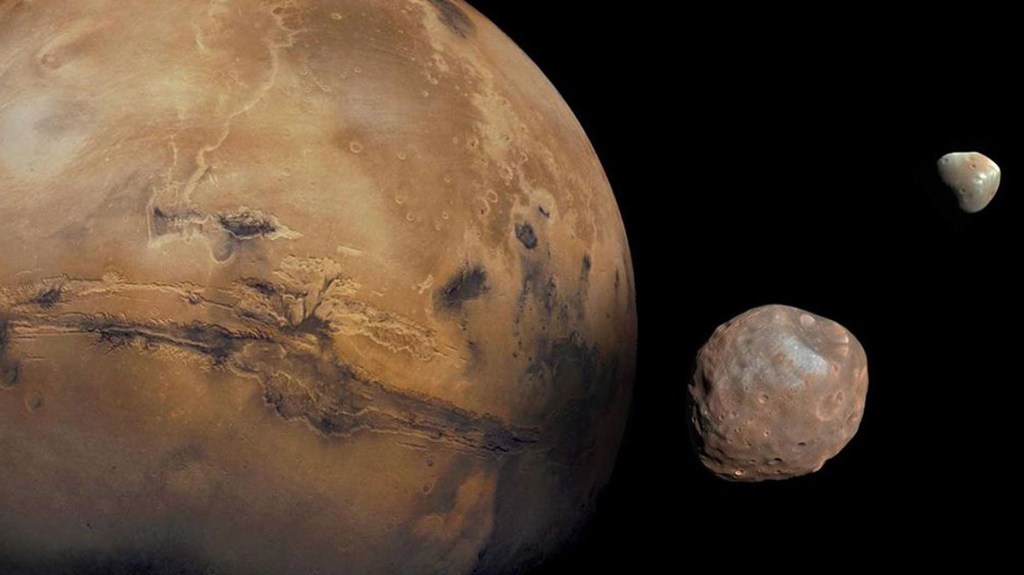
NASA/JPL-Caltech/GSFC/Univ. of Arizona
Jupiter boasts a fascinating collection of moons, including the largest in the solar system, Ganymede. The Jovian system also contains Europa, an ocean moon that will be the focus of exploration by the upcoming Europa Clipper mission. Jupiter’s other major moons include the volcanic Io and the cratered Callisto. Saturn, Uranus, and Neptune also possess irregular moons that orbit at great distances from their planets.
Saturn holds the record for the most moons, with 293 confirmed as of August 2026. Among these are the ocean moons Enceladus and Titan. Titan is the second largest moon in the solar system and is unique for having a thick atmosphere and surface seas of liquid ethane and methane. Meanwhile, embedded within Saturn’s rings are small moonlets known as shepherd moons, which help maintain the structure of the rings.

On Feb. 24, 2009, the Hubble Space Telescope took a photo of four moons of Saturn passing in front of their parent planet. In all, Saturn has 274 confirmed moons, far more than any other planet in our solar system.
Credits: NASA, ESA, the Hubble Heritage Team (STScI/AURA); Acknowledgment: M.H. Wong (STScI/UC Berkeley) and C. Go (Philippines)
In the realm of the ice giants, Uranus has 29 known moons. Its inner moons appear to be composed of roughly equal parts water ice and rock. The most unusual is Miranda, whose surface bears the scars of ancient, massive impacts. Neptune has 16 known moons, the largest being Triton. Discovered by the amateur astronomer William Lassell in 1846, Triton orbits backwards compared to Neptune’s rotation.
Beyond the major planets, our dwarf planets also have their own companions. Pluto’s large moon, Charon, is half the size of Pluto itself. Eris has a moon named Dysnomia, and Haumea has two satellites, Hi’iaka and Namaka. Interestingly, Ceres, the closest dwarf planet to the Sun, remains solitary with no moons at all.
Each of these moons offers a glimpse into the complex history of our solar system. Whether they are volcanic, icy, or literary in name, they remind us that the wonders of space are not limited to the planets alone.