

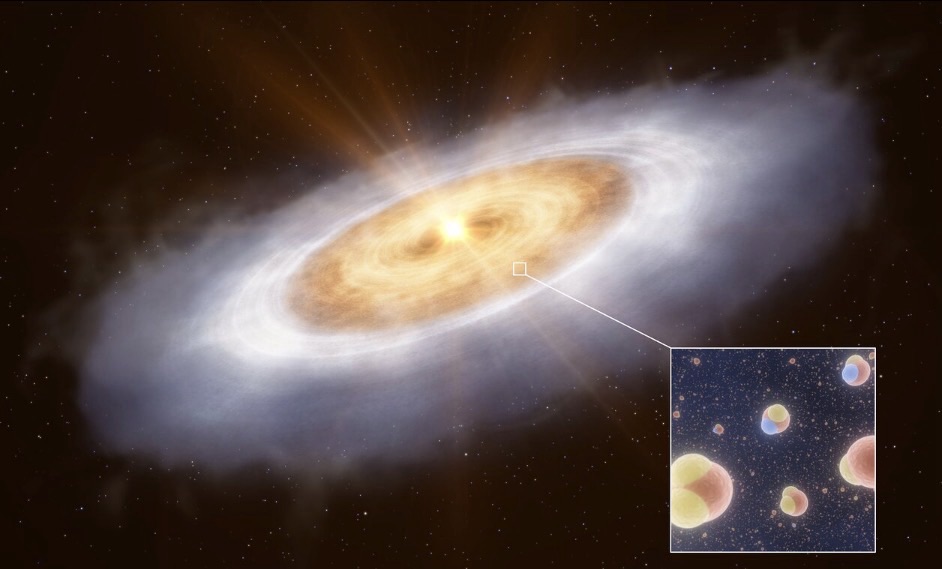
A thought for my fellow cosmic drinkers. That sip of water in your glass? It might hail from interstellar clouds predating our Sun by billions of years. Astronomers peering at V883 Orionis, a young star 1300 light-years away in Orion, used ALMA to spot gaseous water in its protoplanetary disc with a deuterium ratio matching our Solar System’s comets and oceans. This heavy water – one or even two hydrogen atoms swapped for deuterium – acts as a clean chemical fingerprint, formed in frigid clouds where such ratios lock in.
V883 Orionis’s rare outburst heated its disc, vaporising ice into detectable gas, revealing at least 1200 times Earth’s ocean water. Recent detections even include doubly deuterated water (D2O), the first in any planet-forming disc, confirming this inheritance without reprocessing.
While traditional models have long suggested that water and other volatiles form within protoplanetary discs, this discovery raises intriguing questions. If a significant portion of Earth’s water came from ancient interstellar sources, does this fundamentally change our understanding of how volatiles are delivered to planets? The presence of the chemical fingerprint that aligns remarkably with water in comets and Earth’s oceans suggests we might be dealing with a more complex narrative where different regions of these discs inherit a mix of compositions derived from their cosmic origins.
Moreover, as V883 Orionis undergoes its outburst, the dynamic conditions that allow for this water to become detectable challenge our existing models. If water can travel intact from these cold star-forming regions instead of forming in situ, we must reconsider the mechanisms by which volatiles migrate to forming planets. This raises exciting discussions about the processes and timelines involved in this cosmic transport.
If planets receive sizable amounts of water straight from interstellar sources rather than brewing them locally, this implies that we might have overlooked crucial pathways that foster life-supporting environments. The findings from V883 Orionis invite a re-evaluation of our “closed system” approach to protoplanetary discs by incorporating these external contributions as vital sources of water and other volatiles.
As we continue to explore the universe, future scopes like ESO’s Extremely Large Telescope with METIS will delve deeper into these tantalising mysteries, probing further into how many other planetary systems might also inherit ancient, life-enabling oceans from the depths of interstellar space.
The image below shows an artist impression of water in the planet-forming disc around the star V883 Orionis (Credit: ESO/L. Calçada)
So, what deuterium ratio would you expect in your morning coffee if Earth truly inherited pristine water? Share your thoughts below.