

On 21 June 2025 at 12:31 pm AEST ()2:31 UTC), the Southern Hemisphere will experience the Winter Solstice—when the Sun reaches its most northerly point in the sky. It marks the shortest day and longest night of the year, as the Sun traces its lowest and shortest arc across the sky.
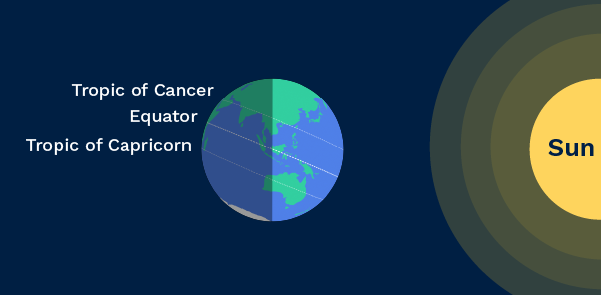
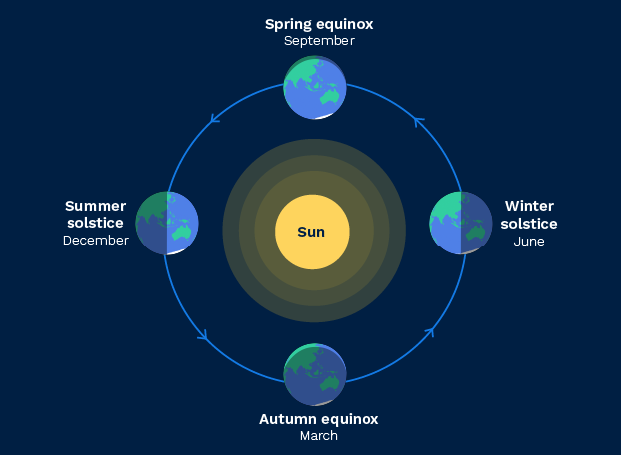
This astronomical event is caused by Earth’s 23.5° axial tilt, which governs the changing seasons. As our planet orbits the Sun, this tilt causes the Sun’s apparent position in the sky to shift north and south throughout the year. The solstices—winter and summer—are the extremes of this cycle, while the equinoxes mark the midpoints when day and night are nearly equal.
🌗 What About the Equilux?
While the equinox is the astronomical moment when the Sun crosses the celestial equator, the equilux is the day when daylight and darkness are exactly equal—a subtle but important distinction. Due to atmospheric refraction and the way sunrise and sunset are defined (from the first and last visible edge of the Sun), the equilux does not occur on the same day as the equinox.
In the Southern Hemisphere, the June equilux typically occurs a few days after the solstice. For example, in cities like Sydney (around 35°S latitude), the equilux in 2025 is expected to fall on 24 June. That’s when the length of day and night will be closest to a perfect 12 hours each.
It’s a beautiful reminder that even in science, precision and perception can diverge—and that nature rarely conforms to our neat definitions.

🌏 Cultural Significance of the Solstice
For thousands of years, cultures worldwide have marked the solstices with ceremony, storytelling, and reflection. In the Southern Hemisphere, many First Nations peoples have long observed the rhythms of the sky to guide seasonal activities, ceremonies, and ecological knowledge.
For example, in parts of Australia, the appearance of certain stars or the timing of the solstice would signal the start of seasonal food gathering or ceremonial periods. The Yolŋu people of Arnhem Land observe the rising of specific constellations to mark seasonal changes, while the Boorong people of northwestern Victoria integrated celestial knowledge into their oral traditions and daily life.
The solstice is not just a scientific event—it’s a cultural compass, a moment to pause, reflect, and realign with the cycles of nature.
🌃 A Sky Under Threat
While the solstice invites us to look up, we must also acknowledge what we’re losing. According to the 2025 State of the Science report by DarkSky International, light pollution is increasing at a rate of nearly 10% per year in some regions. In Australia, many urban and suburban areas are now so brightly lit that the Milky Way is no longer visible to the naked eye.
This has profound implications—not just for astronomers, but for ecosystems, human health, and cultural heritage. The night sky has always been a source of wonder, orientation, and storytelling. Losing it means losing a part of ourselves.
🌌 A Moment to Reconnect
So this 21 June, I encourage you to step outside—whether at midday to mark the solstice itself, or later that evening to embrace the long night. Reflect on the Sun’s journey, the Earth’s tilt, and your own path through the year.
Ask yourself:
🌱 What kind of night are we leaving for future generations?
🌟 What seeds—scientific, cultural, or personal—can we plant in this moment of stillness?
Because even in the darkest night, the light begins to return.