

Exciting news for astronomy enthusiasts! The brightest comet in nearly two decades, Comet G3 ATLAS (C/2024), is expected to reach its peak brilliance later this week into early next week. It is predicted to be as spectacular as 2007/Comet P1 McNaught which graced our skies in January 2007! But the burning question on everyone’s mind is: “Will you actually be able to see it?
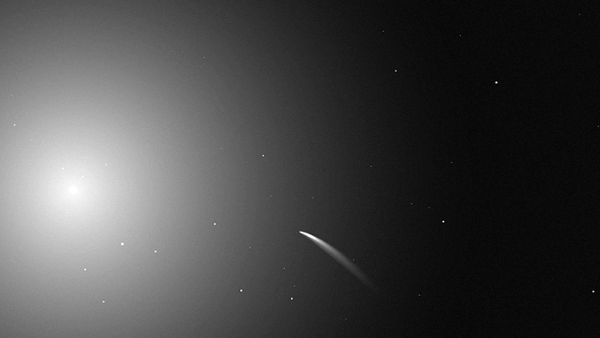
Comet G3 ATLAS was first spotted on April 5, 2023, by the Asteroid Terrestrial-impact Last Alert System (ATLAS) survey. Observations were made using a 0.5-metre reflector telescope in Rio Hurtado, Chile. At the time of its discovery, the comet was a staggering 655 million kilometres away from Earth and shone at a faint magnitude of +19—roughly 158,000 times dimmer than the faintest star visible to the naked eye.
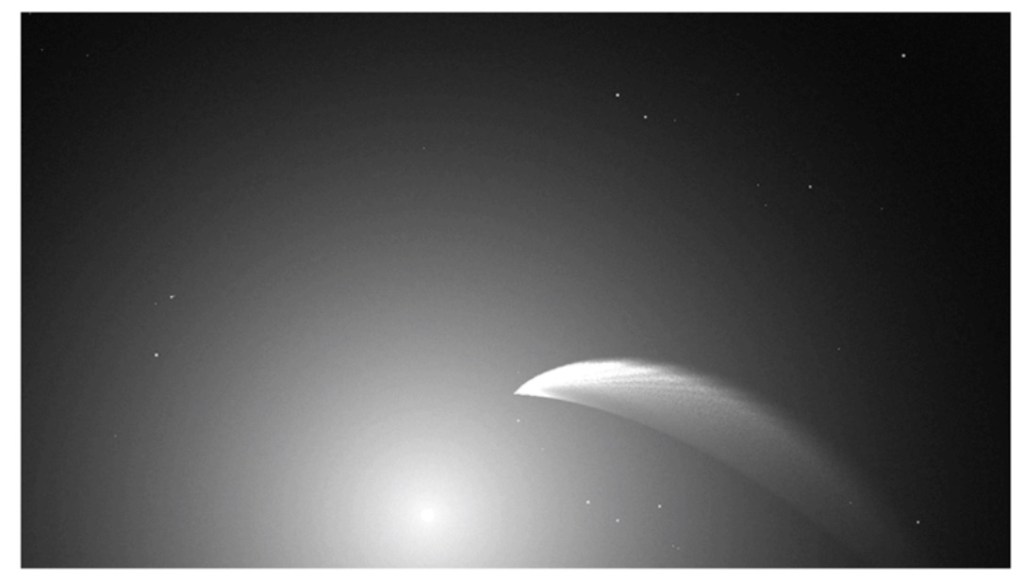
French optical engineer and amateur photographer, Nicholas Lefaudeux, the sun is surrounded by a glow that represents the area of the sky affected by twilight. As the comet whirls around the Sun, take note of the changing orientation of its blue gas tail and curved, white dust tail.(Image credit: Nicolas Lefaudeux)
Initial calculations indicated that this comet would pass exceptionally close to the sun, coming within 14 million kilometres in mid-January 2025—only about one-quarter the distance of Mercury, the closest planet to the sun. G3 ATLAS is believed to be a new comet, making its first approach from the Oort Cloud, a vast region filled with billions of icy objects that encircle our solar system, located about 16 trillion kilometres from the sun. However, comets like G3 ATLAS, which skim closely by the sun for the first time, often disintegrate before reaching their closest approach.
So far, the predicted path of G3 ATLAS has favoured observers in the Southern Hemisphere. Its trajectory has taken it through southern constellations like Lupus and Scorpius, and it currently resides in Sagittarius. Unfortunately, for those in the Northern Hemisphere, the comet has been too low on the southeastern horizon, often obscured by the bright glow of morning twilight.
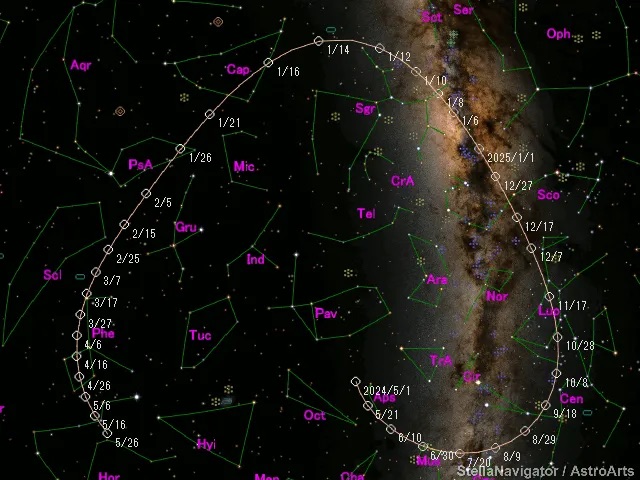
The path of Comet G3 ATLAS across constellations — primarily of the southern skies –is depicted by Japanese comet expert Seiichi Yoshida)
However, as G3 ATLAS approaches its perihelion, it has begun to brighten significantly. For a brief period, its path will curve just far enough north to give those in the Northern Hemisphere a chance to catch a glimpse of this celestial wonder.
So, grab your binoculars and head outside! Keep an eye on the southeastern horizon and get ready to witness this spectacular event. Will you be able to see it? Only time will tell, but it’s certainly worth the effort to look up at the night sky!
Happy stargazing! 🌌✨