

The ancient Celts marked the summer and winter solstices as significant moments when the length of daylight began to shift. This December, the solstice will occur at 8:19 PM AEDT on December 21. At this time, the South Pole of the Earth will be tilted towards the Sun, which will be at its southernmost point in the sky, directly over the Tropic of Capricorn at 23.44 degrees south latitude. This day marks the beginning of winter (winter solstice) in the Northern Hemisphere, while in some countries in the Southern Hemisphere, it signifies the start of astronomical summer (summer solstice).
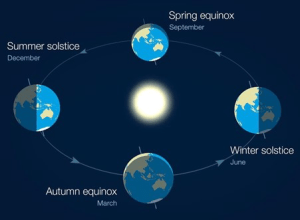
If you’ve been able to catch the sunrise or sunset regularly—though it might have been a bit challenging lately in the eastern states due to all the rain and cloud—you may have noticed that the Sun rises and sets in different positions each day along the horizon. This is a result of the Earth’s tilt and orbit. Throughout the year, the point on the horizon where the Sun rises and sets shifts north, then south, and back again. The days when it reaches its furthest points and changes direction are known as the solstices. The term ‘solstice’ is derived from ancient Latin, where ‘sol’ means sun and ‘sistere’ means to stand still.
On December 21, the Sun will have reached its most northern position. After this, it will start to appear to move further south each day. It could be enjoyable to keep track of where the Sun sets over the next few months. You don’t need to do this every day; perhaps try it once a week. Take note of where the Sun sets against the horizon and observe its movement week after week. You should be able to catch the last of its northern motion before it changes direction on December 20 and begins its journey southward.
The December solstice is also the longest day of the year for those in the Southern Hemisphere. After this point, the days will gradually become shorter. However, keep in mind that this doesn’t mean that sunset will happen earlier. In fact, it continues to get later as summer unfolds. The later sunrises each day will start to reduce the overall length of daylight, marking this day as the maximum length of daylight for the year.