

In the ever-expanding field of astronomy, each day brings forth astonishing revelations that enhance our understanding of the cosmos. Today, we focus on one of the most extraordinary objects in the universe: neutron stars. These dense remnants of massive stars offer profound insights into the fundamental forces that govern the universe.
Understanding Neutron Stars
Neutron stars are the remnants of supernova explosions, the final stage in the lifecycle of massive stars. When a massive star exhausts its nuclear fuel, it undergoes a supernova explosion, leaving behind a core that can collapse into an incredibly dense neutron star. This article delves into the unique characteristics and intriguing phenomena associated with neutron stars.
The Formation of Neutron Stars
The formation of a neutron star occurs when a star with a mass between approximately 8 and 25 times that of the Sun exhausts its nuclear fuel. The core collapses under gravity’s intense pressure, leading to a supernova explosion that ejects the outer layers of the star. The remaining core compresses to a point where protons and electrons merge to form neutrons, resulting in a neutron star.
Incredible Density and Size
One of the most striking features of neutron stars is their density. A neutron star’s mass typically ranges from 1.4 to 2.16 solar masses, but it is packed into a sphere with a radius of about 10 to 15 kilometers. This means that a sugar-cube-sized amount of neutron star material would weigh around 100 million tons on Earth.
Key Characteristics of Neutron Stars
Neutron stars exhibit several fascinating characteristics that make them subjects of intense scientific study.
Intense Gravitational Fields
The gravitational field of a neutron star is extraordinarily strong, approximately 2 billion times the gravity of Earth at the surface. This intense gravity warps spacetime around the star, creating phenomena such as gravitational lensing, where light from objects behind the neutron star is bent around it.
Rapid Rotation
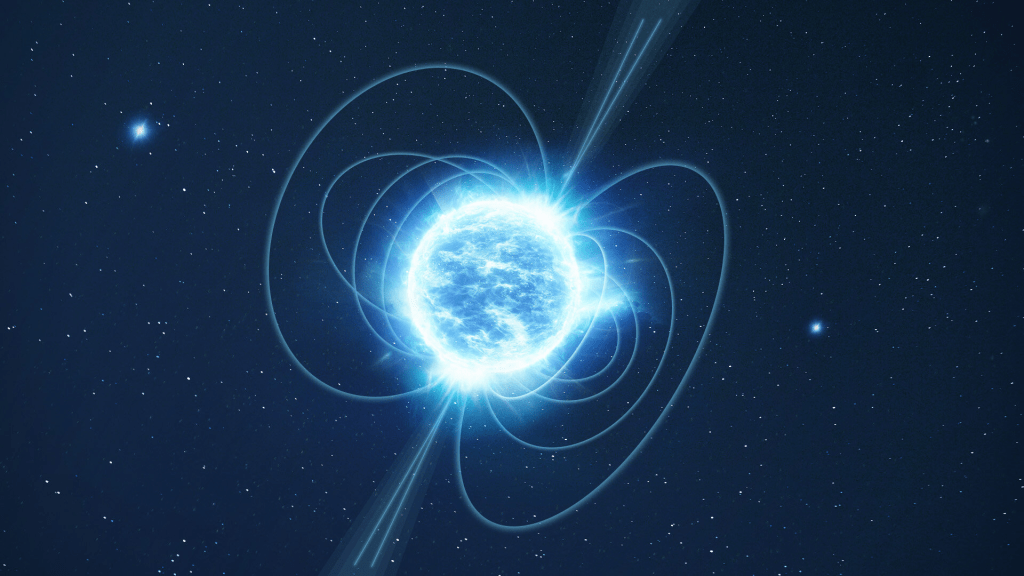
Neutron stars are known for their rapid rotation. After the supernova explosion, the conservation of angular momentum causes the neutron star to spin at incredibly high speeds. Some neutron stars, known as pulsars, can rotate hundreds of times per second. These pulsars emit beams of electromagnetic radiation from their magnetic poles, which, when aligned with Earth, can be observed as pulses of radiation.
Strong Magnetic Fields
Neutron stars possess some of the strongest magnetic fields in the universe, estimated to be up to 1 quadrillion times stronger than Earth’s magnetic field. These powerful magnetic fields influence the behavior of the neutron star’s surrounding matter and radiation, contributing to the emission of high-energy particles and X-rays.
Neutron Stars in the Cosmos
Neutron stars play a significant role in the cosmos, offering insights into high-energy astrophysics and the fundamental nature of matter.
Binary Neutron Star Systems
Many neutron stars exist in binary systems, orbiting a companion star. These binary neutron star systems are valuable for studying gravitational interactions and the behavior of matter under extreme conditions. The discovery of gravitational waves from such systems, detected by observatories like LIGO and Virgo, has confirmed the existence of neutron star mergers and provided new insights into the cosmos.
Neutron Star Mergers
When two neutron stars in a binary system collide, they create a neutron star merger. These events are among the most energetic in the universe, producing gravitational waves and electromagnetic radiation across various wavelengths. The first detection of a neutron star merger, observed by the LIGO and Virgo collaborations in 2017, provided evidence for the synthesis of heavy elements such as gold and platinum in such collisions.
Observational Techniques
Observing neutron stars involves various advanced techniques and instruments. Radio telescopes detect the pulsating signals from pulsars, while X-ray telescopes and gamma-ray observatories capture high-energy emissions from neutron stars and their surrounding accretion disks. The use of these instruments has led to numerous discoveries and a deeper understanding of neutron star phenomena.
Theoretical Implications and Research
The study of neutron stars has significant implications for theoretical physics and our understanding of fundamental forces.
Equation of State for Neutron-Star Matter
One major area of research is determining the equation of state for neutron-star matter, which describes how matter behaves under the extreme densities found in neutron stars. This research helps scientists understand the fundamental properties of nuclear matter and the behavior of matter in conditions not replicable on Earth.
Testing Theories of Gravity
Neutron stars serve as natural laboratories for testing theories of gravity. The strong gravitational fields of neutron stars provide a unique environment to test general relativity and explore deviations from Einstein’s theory. Observations of neutron star interactions and gravitational waves offer valuable data for refining our understanding of gravity.
Conclusion
Neutron stars represent one of the most fascinating and extreme phenomena in the universe. Their incredible density, intense gravitational fields, rapid rotation, and strong magnetic fields provide crucial insights into the fundamental forces and processes governing the cosmos. As observational technologies and theoretical models continue to evolve, our understanding of these enigmatic objects will undoubtedly deepen, revealing even more about the nature of the universe.