

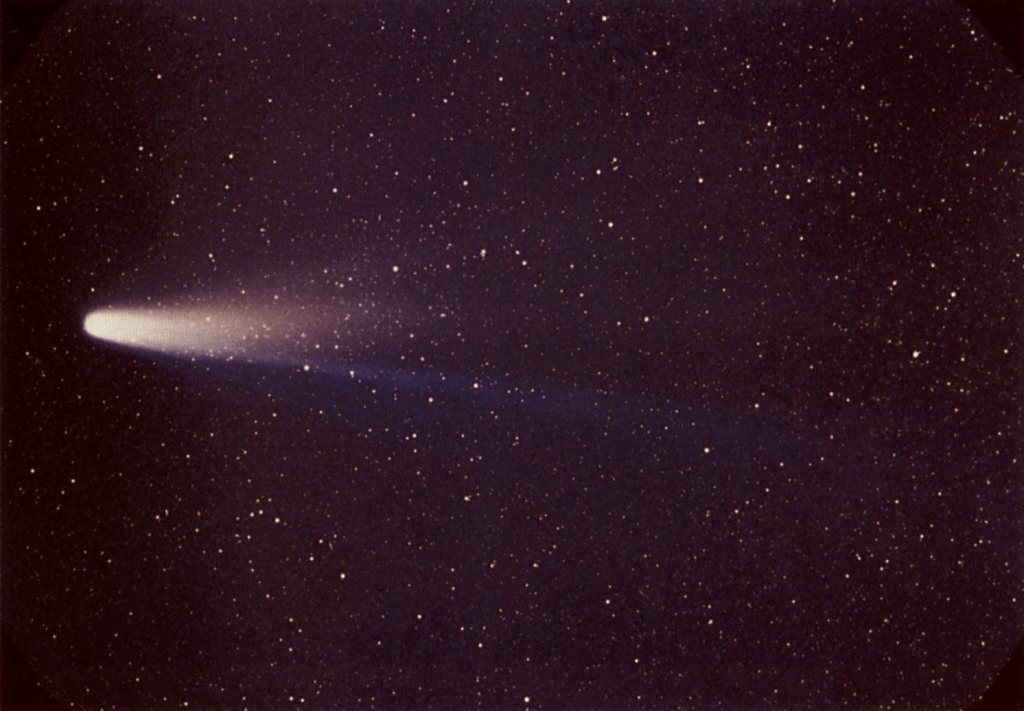
NASA/National Space Science Data Centre
Comets are truly fascinating celestial objects that never fail to capture our imagination. Made up of ice, dust, and rock, comets orbit the Sun in a mesmerising dance through space.
Known as “dirty snowballs,” comets are believed to have formed in the early stages of our solar system and hold valuable information about its origins and development.
There are two main types of comets: short-period comets and long-period comets. Short-period comets have orbits of less than 200 years and are thought to come from the Kuiper Belt, a region beyond Neptune. Long-period comets, with orbits exceeding 200 years, are believed to originate from the Oort Cloud, a vast reservoir of icy objects in the outer solar system.
When comets approach the Sun, the heat causes the ice within them to vaporize, forming a glowing coma and a tail that can stretch millions of kilometres across the sky.

This dazzling display has been observed by humans for thousands of years.
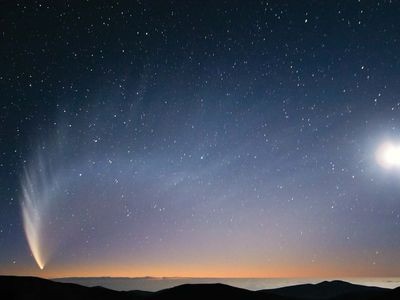
Some of the most famous comets include Halley’s Comet, which graces Earth approximately once every 76 years, and Comet McNaught, one of the brightest comets in recent memory.
C/2007 Q3 (Siding Spring), is an Oort cloud comet that was discovered by myself in 2007 at Siding Spring Observatory in New South Wales, Australia. It was the second of my comet discoveries but gave me my 10 minutes of fame by being the image released by NASA WISE satellite.
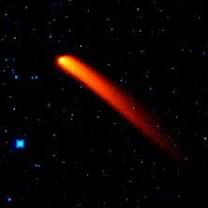
The comet came within 1.2 astronomical units of Earth and 2.25 AU of the Sun on October 7, 2009. The comet was visible with binoculars until January 2010.
In conclusion, comets are extraordinary celestial bodies that provide us with a glimpse into the past and offer valuable insights into the formation and evolution of our solar system. Their beauty and mystery continue to captivate astronomers and stargazers alike, making them a truly special sight in our night sky.