

Named for the Roman goddess of dawn, the Aurora is an amazing and enthralling display of light in the night sky. The aurora borealis and aurora australis which a are also called the northern lights and southern lights occur at the northern and southern poles.
They are caused by the solar wind, a stream of charged particles from the Sun. When the solar wind collides with Earth’s magnetic field, it creates a disturbance known as a geomagnetic storm.
This storm causes the magnetic field to bend, allowing charged particles to enter the Earth’s atmosphere near the poles. As these particles interact with atmospheric gases, they emit light, creating the stunning displays we see as aurorae.
Solar flares are eruptions from the sun’s surface that release bursts of electromagnetic radiation.
They are classified into groups based on size, with X-class being the most powerful. Following X-class are M-class flares, which are 10 times weaker, then C-class, B-class, and A-class, with each subsequent class being 10 times weaker than the one before it. A-class flares have no significant impact on Earth. Within each class, numbers from 1-10 describe the relative strength of the flare.
Aurorae not only provide a visual spectacle but also have practical effects. They can also disrupt HF radio communications, GPS signals, and power grids, leading to potential disruptions in telecommunications and navigation systems.
There are several sunspots currently visible on the surface of the Sun with one particularly large and complex spot, region AR3691, directly facing Earth. The NOAA’s Space Weather Prediction Center has forecasted minor to moderate solar flare activity from sunspot regions AR3697 and AR3691 from May 29 to May 31, increasing the likelihood of more X-flare activity.

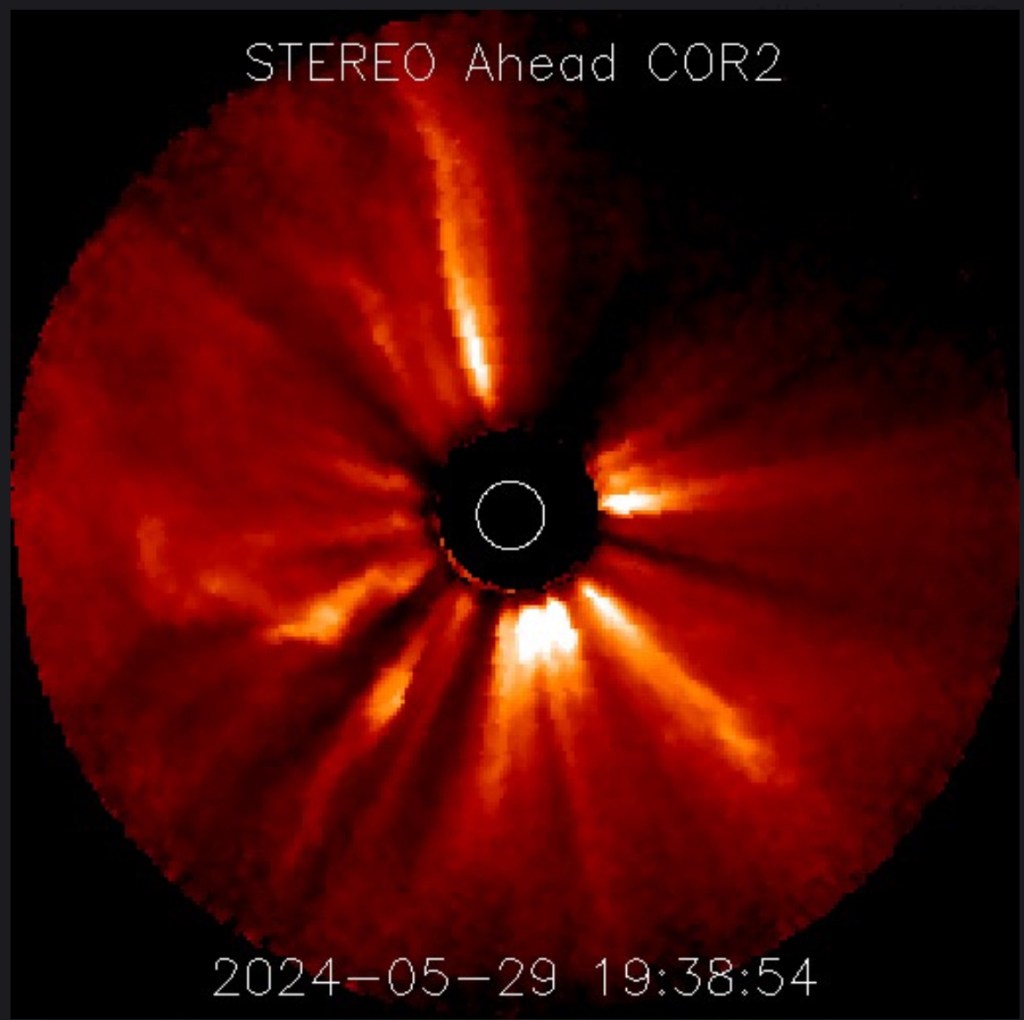
Sunspot AR13664 which provided the amazing light shows on May 10/11 makes a spectacular return to the west limb with a beautiful X flare in progress and what looks to be a CME (directed away from us unfortunately).
The sunspot should be in an earth facing position in around 3 to 6 days later this week, but anything is possible.
Scientists are closely monitoring AR3697 as it moves across the sun’s surface and approaches Earth. Sunspot regions like this have the potential to cause coronal mass ejections (CMEs), which are bursts of plasma and magnetic field from the Sun.
Additionally, aurorae can influence the behaviour and migration patterns of animals that rely on Earth’s magnetic field for navigation.
These natural light shows also hold cultural significance for many indigenous peoples around the world.
In Australian Indigenous, Polynesians and Native American and Inuit cultures, the Northern and Southern Lights are viewed as a spiritual phenomenon, often seen as messages from the gods or spirits.
In conclusion, aurorae are a beautiful example of the interplay between the Earth and the Sun. The interactions between solar flares and Earth’s magnetic field create the mesmerizing effect of aurorae, with the strength of the solar flares determining the intensity of the light show.
Next time you witness the shimmering lights of an aurora in the night sky, remember the cause and effects that produce this natural wonder.
Hi Donna
I spent time in Iceland a few years ago. What a fantastic place to go. Swimming in the Blue Lagoon! However was very disappointed with the Northern LIghts. 1 am, extremely cold and only a vague whitish whisper in the night sky. We were told that last night was fantastic, not on our night. We had a great time there.
Regards
John
ps really enjoy your emails.
Would love to visit Iceland – so quite jealous of your adventure- sounds amazing