

In a recent paper published in Astronomy and Astrophysics, scientists have confirmed the discovery of a new trojan asteroid orbiting Mars. This new asteroid, which travels ahead of Mars in its orbit, is different from other trojan asteroids as it may not have a stable orbit, leading to interesting questions about its history.
Trojan asteroids are small objects that share the orbit of a planet and move along with it. They are positioned at specific points around two gravitational bodies, like the Sun and a planet, called Lagrangian (L) points.
One of these points is on the opposite side of the orbit, one is between the planet and the Sun, and one is slightly behind the planet.
Additionally, there are two points on the orbit itself, one preceding at 60° (L4) and one following at 60° (L5).
While Earth has only two known trojan asteroids, studying them is challenging. Mars, on the other hand, has 17 trojans, with most of them in the following group. In the preceding group, there is only one other asteroid, named 1999 UJ7, which researchers believe may be related to the newly confirmed asteroid, 2023 FW14.
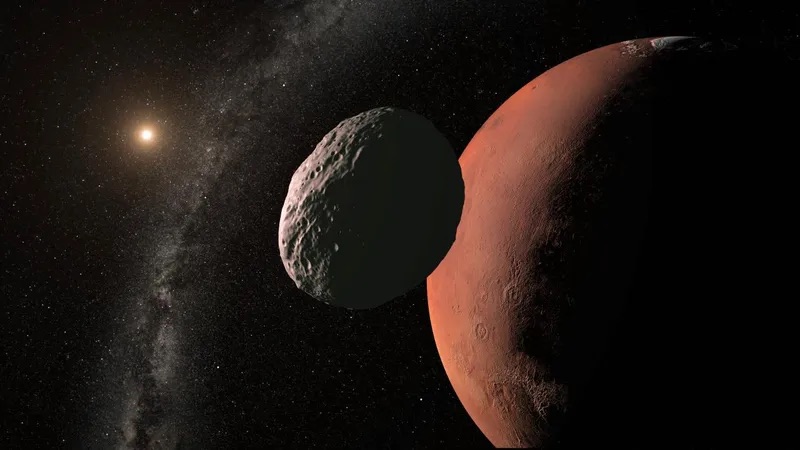
Image credit: Gabriel Pérez Díaz (SMM, IAC)
There are two possible origins for 2023 FW14: it could be a piece of the trojan asteroid 1999 UJ7, or it might have been captured from the population of asteroids near Earth that cross Mars’ orbit.
The confirmation of 2023 FW14 as a Martian trojan asteroid was made using the Gran Telescopio Canarias (GTC), which also collected the light spectrum of the object. Analyzing the spectrum helps astronomers understand the composition of celestial objects from a distance, providing valuable insights into the asteroid’s origin.
Although the spectrum of 2023 FW14 obtained with the GTC differs slightly from that of the L4 Trojan 1999 UJ7, both asteroids belong to the same composition group known as primitive asteroids, unlike the L5 Trojans which are rocky and rich in silicates.