

67P/Churyumov–Gerasimenko is a comet that follows an orbit around the Sun. Discovered in 1969 by Klim Churyumov and Svetlana Gerasimenko, the comet’s nucleus is irregularly shaped and has a diameter of approximately 4 kilometres. It rotates with a period of about 12.4 hours.
Rosetta Mission
This comet gained prominence as the target of the European Space Agency’s Rosetta mission, which successfully deployed a probe on its surface in 2014. The mission yielded valuable insights into the composition and structure of the comet, enhancing our understanding of its characteristics.

Orbital Characteristics
Due to its proximity to the Sun, the comet’s icy nucleus sublimates, forming a coma and a tail. It follows an orbit with a relatively long period of about 6.45 years. The comet’s surface features various terrains, including cliffs, pits, and smooth areas, along with dynamic activities such as outbursts and gas and dust jets.
Scientific Significance
The Rosetta mission not only explored 67P/Churyumov–Gerasimenko but also provided crucial information about the early solar system and the formation processes of comets. The data gathered during the mission contributed significantly to our knowledge of these celestial bodies.
Details of Image
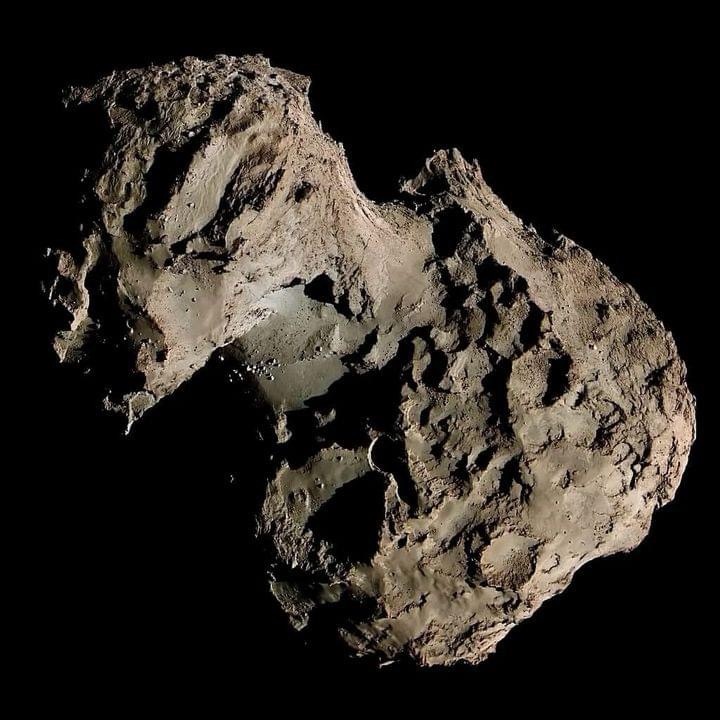
This photo is an approximate true color image of comet 67P taken by the Rosetta spacecraft’s OSIRIS Narrow Angle Camera on March 17, 2015. This image is a four-frame mosaic, with each color frame imaged through VIS_BLUE, VIS_GREEN, and VIS_RED filters. At the time this image was taken, Rosetta was located roughly 82 km from the comet’s center.
Credit: ESA / Rosetta / MPS for OSIRIS Team (MPS / UPD / LAM / IAA / SSO / INTA / UPM / DASP / IDA) / Justin Cowart