

Oberon and Titania were the first two Uranian moons ever discovered. The finding came just six years after Herschel actually discovered the planet itself. These were the two largest moons, Titania and Oberon.
Astronomers discovered three more moons, Umbriel and Ariel in 1851, and Miranda in 1948.

Image credit: Mt. Wilson Observatory
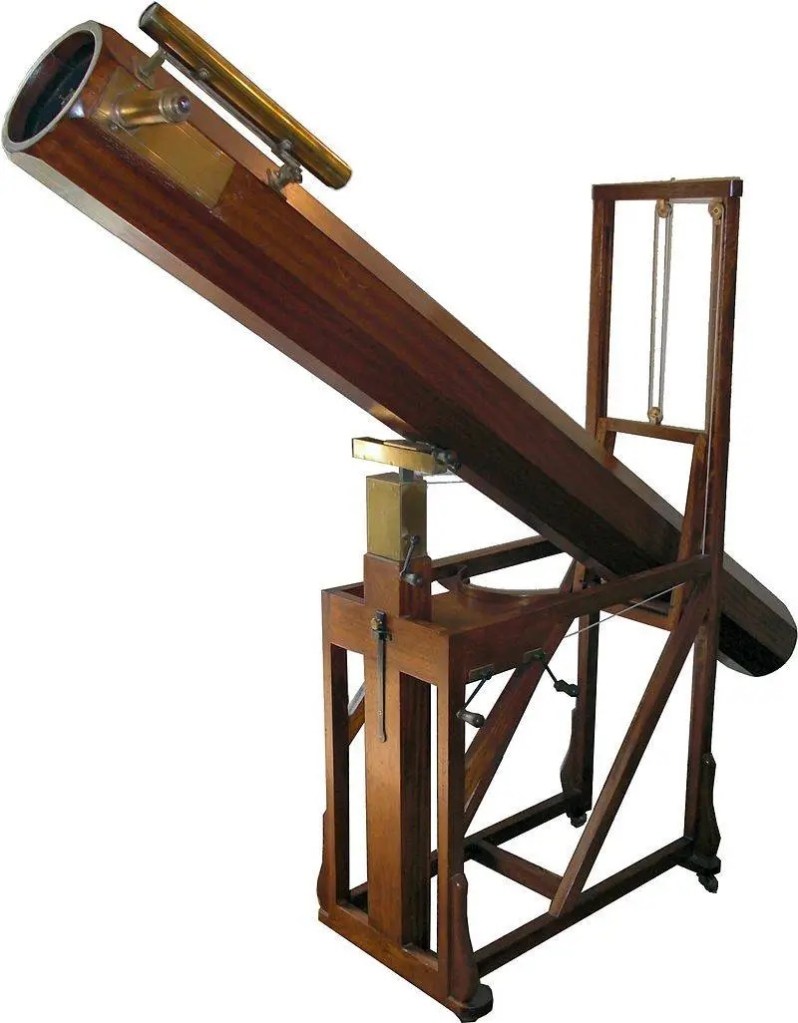
Herschel used in his observations of Uranus. Image credit: Herschel Museum of
Astronomy, Bath, United Kingdom
Because of its great distance from Earth, for the next 200 years astronomers knew little about Uranus other than its five moons and the discovery in 1977 of rings around the planet. Voyager 2’s flyby in 1986 greatly increased our knowledge of this distant world.Because of its great distance from Earth, for two centuries, astronomers knew little about Uranus other than its five moons and the discovery in 1977 of rings around the planet. Voyager 2’s flyby in 1986 greatly increased our knowledge of this distant world.
Currently astronomers have discovered 27 moons around Uranus, and all of them are named after characters from the works of William Shakespeare and Alexander Pope.
“Sweet Moon,” William Shakespeare wrote in “A Midsummer Night’s Dream,” “I thank thee for thy sunny beams; I thank thee, Moon, for shining now so bright.” Centuries later, the moons of Uranus pay homage to the famous playwright.

(Image credit: Smithsonian Institution)