

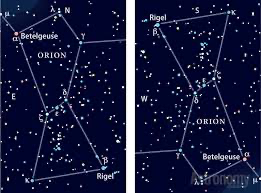
Betelgeuse is a red supergiant star located in the constellation of Orion. It is one of the largest and brightest stars visible to the naked eye, and it is easily recognizable as the reddish star on the upper left shoulder of the Orion constellation.
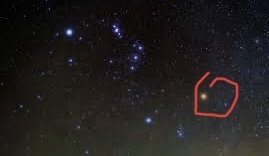
Here are some key facts about Betelgeuse:
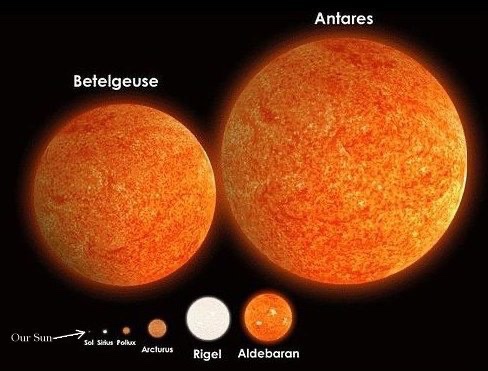
1. Size and Distance: Betelgeuse is estimated to be around 700 times larger than our Sun, making it one of the largest known stars. It is also one of the closest red supergiants to Earth, located at a distance of approximately 640 light-years.
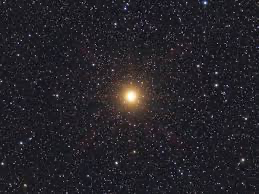
2. Brightness: Betelgeuse is a highly luminous star, with an apparent magnitude that varies between 0.0 and 1.3. It is considered a variable star, meaning its brightness fluctuates over time. At its brightest, Betelgeuse is one of the ten brightest stars in the night sky.
3. Colour and Temperature: The reddish colour of Betelgeuse indicates its relatively low surface temperature compared to other stars. It has an effective temperature of around 3,500 , which is significantly cooler than our Sun.
4. Age and Evolution: Betelgeuse is relatively young, with an estimated age of around 8 to 10 million years. It is currently in the later stages of its life cycle and is expected to explode as a supernova within the next few hundred thousand years. But we will have to wait 640 years after it happens to actually see it.
5. Supernova Potential: When Betelgeuse eventually explodes as a supernova, it will release an enormous amount of energy and briefly outshine the entire galaxy. This event will likely be visible from Earth, even during the daytime, and could have significant effects on our planet’s atmosphere. The last supernova directly observed was Keplers Supernova in 1604, appearing not long after Tycho’s Supernova in 1572, both of which were visible to the naked eye.
6. Constellation and Mythology: Betelgeuse is part of the Orion constellation, which represents a hunter in Greek mythology. The name “Betelgeuse” is derived from the Arabic phrase “yad al-jawzā,” meaning “the armpit of the giant.” It refers to the star’s position on Orion’s shoulder.
Betelgeuse continues to fascinate astronomers and stargazers alike due to its immense size, brightness, and the anticipation of its eventual supernova explosion.

Additionally, Betelgeuse has been the subject of scientific study and observation for many years. Astronomers have used various techniques, such as interferometry and spectroscopy, to gather information about its size, temperature, and composition. These studies have provided valuable insights into the life cycle of massive stars and the processes that occur within them.
One notable characteristic of Betelgeuse is its pulsations. It undergoes regular changes in size and brightness, with periods ranging from a few months to a few years. These pulsations are believed to be caused by the star’s outer layers expanding and contracting, similar to the beating of a heart. Studying these pulsations can help astronomers understand the internal structure and dynamics of red supergiants.
Betelgeuse has also been observed to have a complex and extended atmosphere, with the presence of large convective cells and massive gas plumes. These features contribute to the star’s variability and may play a role in its eventual supernova explosion.
In recent years, Betelgeuse has attracted attention due to its unprecedented dimming. In late 2019 and early 2020, the star experienced a significant decrease in brightness, leading to speculation about an imminent supernova event. However, subsequent observations have shown that the dimming was likely caused by a combination of stellar activity and dust obscuration.
Despite the uncertainties surrounding its future, Betelgeuse remains a captivating object in the night sky. Its size, brightness, and unique characteristics make it a fascinating subject of study for astronomers and a source of wonder for stargazers around the world.
Some Trivia – Betelgeuse in fiction
Betelgeuse was star system XY8S Z GAMMA and the home system of both Ford Prefect and Zaphod Beeblebrox in ‘Hitchhikers Guide to the Universe’. The life forms of Betelgeuse planets are carbon based. (Please note in reality there are no planets around the star.)
The Expanse” series by James S.A. Corey: In this science fiction book series, which has also been adapted into a TV show, Betelgeuse is mentioned as a significant location in the universe. It is a star system that plays a role in the story’s interstellar politics and exploration.
“Star Trek” franchise: Betelgeuse is referenced in various “Star Trek” episodes and movies. It is often mentioned as a star system or a destination for space travel. In the original series, it is mentioned as a location of a Federation starbase.
“Dune” by Frank Herbert: In this epic science fiction novel, Betelgeuse is mentioned as a star system that is part of the Imperium, the interstellar empire in the story. It is one of the many star systems controlled by the ruling class.
“Planet of the Apes.”In Pierre Boulle’s original novel La Planète des Singes, Ulysse Mérou lands on the planet Soror, which orbits Betelguese. On Soror, where a majority of the novel takes place, the conditions allow for life just like on Earth.
The star inspired the name of Tim Burton’s 1988 film Beetlejuice (featuring Glenn Shadix and Danny Elfman).