

This is a that I am asked frequently and so will endeavour to answer it.
Pluto is no longer considered a planet because of a reclassification by the International Astronomical Union (IAU) in 2006.
Prior to this, Pluto was considered the ninth planet in our solar system. However, the IAU redefined the criteria for what constitutes a planet, and Pluto did not meet these new criteria.
According to the IAU’s definition, a planet must meet three criteria:
1. it must orbit the Sun,
2. it must be spherical in shape, and
3. it must have cleared its orbit of other debris.
While Pluto meets the first two criteria, it fails to meet the third. Pluto’s orbit overlaps with that of Neptune for 20 years every 200 years. the last time this happened was 1979-1999.
Pluto also shares its region of space which is known as the Kuiper Belt, with many other small objects.
These objects are often referred to as Kuiper Belt Objects (KBOs) or Trans-Neptunian Objects (TNOs).
They are typically composed of ice and rock and range in size from a few to hundreds of kilometres in diameter.
Amongst these objects crossing Pluto’s orbit include Eris, Haumea, Makemake, and Orcus. These objects are also considered dwarf planets.
Additionally, there are numerous smaller objects, currently with designations such as 2002 MS4, 2002 UX25, and 2002 TX300, that also cross Pluto’s orbit.
The designations such as 2002 MS4, 2002 UX25, and 2002 TX300 are given to objects in the Kuiper Belt based on the year of their discovery and a sequential number.
The first part of the designation, “2002,” represents the year the object was discovered. In this case, the objects were discovered in the year 2002.
The second part of the designation, such as “MS4,” “UX25,” or “TX300,” is a combination of letters and numbers that are assigned to the object in order of its discovery. These designations are typically assigned by the Minor Planet Center, which is responsible for cataloguing and tracking minor planets, comets, and other small Solar System bodies.
These designations are used to uniquely identify and track objects in the Kuiper Belt and other regions of the Solar System.
As a result of Pluto not meeting the third criteria, the IAU reclassified Pluto as a “dwarf planet.” This means that while Pluto is still a significant object in our solar system, it does not meet the criteria to be considered a full-fledged planet.
As of today, there are still officially only five recognised dwarf planets in our solar system. These are:
1.Pluto: Discovered in 1930, Pluto was considered the ninth planet until its reclassification in 2006.

2.Eris: Discovered in 2005, Eris is slightly larger than Pluto and was one of the factors that led to the redefinition of the term “planet.”
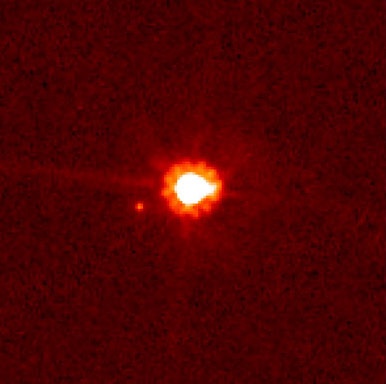
3. Haumea: Discovered in 2004, Haumea is an elongated and rapidly rotating dwarf planet located in the Kuiper Belt.

4. MakeMake: Discovered in 2005, Makemake is the third-largest known dwarf planet and is also located in the Kuiper Belt.
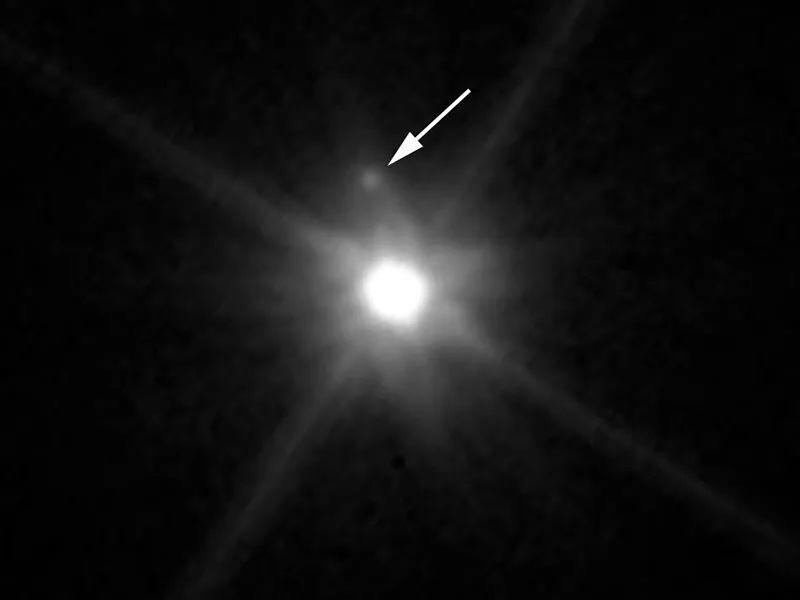
NASA, ESA, and A. Parker and M. Buie (SwRI)
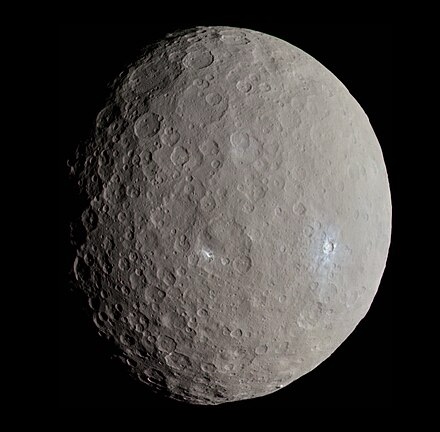
5. Ceres: Discovered in 1801, Ceres is the largest object in the asteroid belt between Mars and Jupiter. It was reclassified as a dwarf planet in 2006.
It’s worth noting that there are several other potential dwarf planets that are currently being studied and evaluated for official recognition.
